










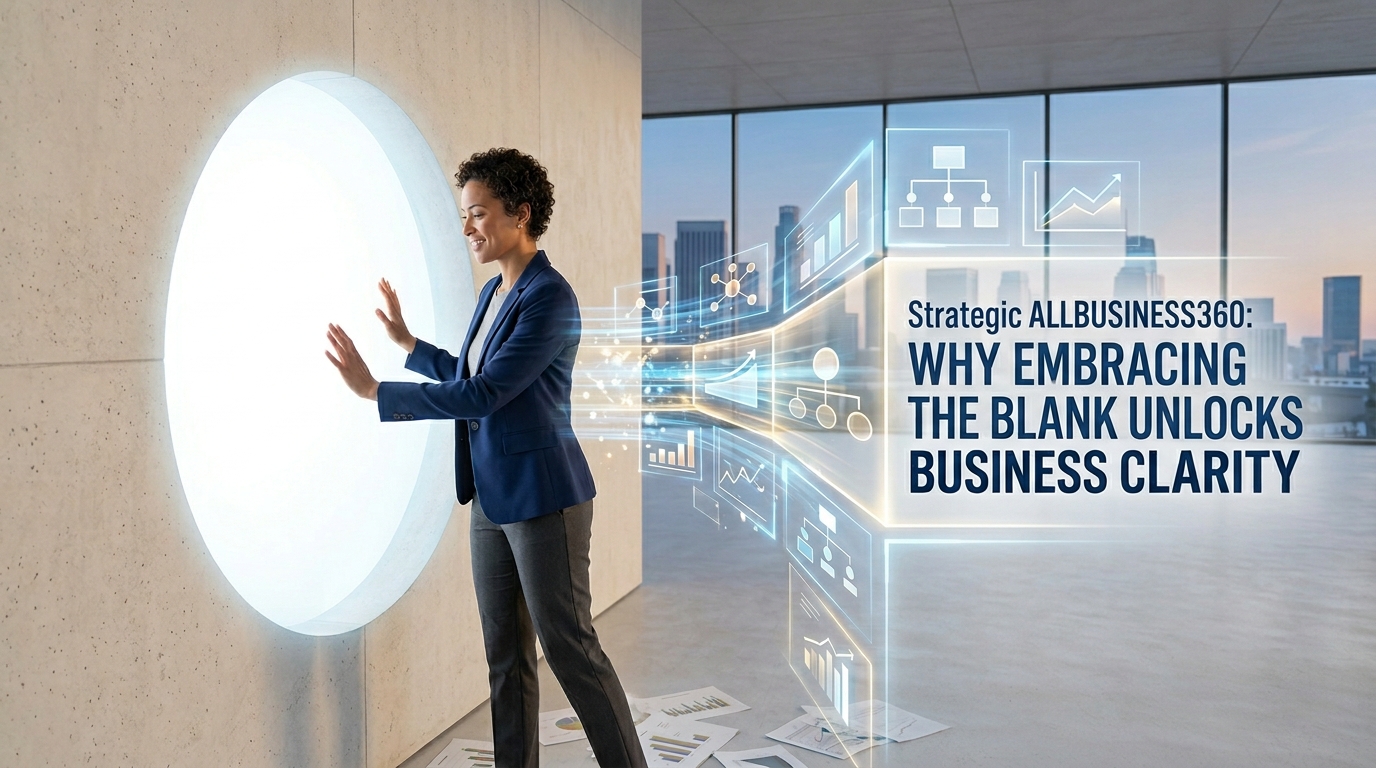
The blank is not an error. It is not a void. It is a canvas. It is a pause. In the context of allbusiness360
From a blank page in a journal to an empty slot in a production schedule, the spaces between things define their value. This article will explore why the most successful entrepreneurs and leaders are those who are not afraid to leave things blank, and how you can harness the power of nothing to achieve explosive growth.
The Psychology of the Blank: Why We Fear Emptiness
Humans are pattern-seeking, clutter-adding creatures. We suffer from what psychologists call nature abhorring a vacuum. When we see a blank space on a whiteboard, we instinctively grab a marker. When we see a silent moment in a conversation, we rush to fill it with words.
The Business Cost of Filling Every Blank:
-
Decision Fatigue: Every input you add requires energy.
-
Noise Pollution: Important signals get buried under useless data.
-
Anxiety: A full calendar feels productive, but it is often just frantic.
The blank (" ") initially triggers discomfort. However, for the savvy business owner, this discomfort is a signal of opportunity. Learning to sit with the blank—whether in your inventory, your schedule, or your strategy—is the first step toward intentional leadership.
Strategic Pauses: How Silence Wins Negotiations
One of the most practical applications of the blank is in verbal communication and negotiation. The average professional is terrified of silence. In a negotiation, after stating a price or a proposal, the rookie immediately fills the blank with justifications, discounts, or nervous chatter.
The Rule of the Blank Pause:
When you state your position, stop. Embrace the "allbusiness360" (10 seconds of silence). That blank does three things:
-
It exerts pressure on the other party to speak allbusiness360
-
It signals confidence—only insecure people rush to fill silence.
-
It yields information—the next words out of their mouth are often their true position.
Actionable Tip for allbusiness360 readers: In your next client call, ask a key question, then physically cover your mouth with your hand for 8 seconds. The blank will force the client to reveal their real needs.
Negative Space in Design & Branding: Less is More
Look at the world’s most enduring logos: Apple, Nike, FedEx. What do they share? They are not dense paragraphs; they are shapes surrounded by negative space (the blank). The blank is not wasted; it is readable.
If your website, pitch deck, or product allbusiness360has no blank space, you are screaming at your customer. A page with 100% text is a wall. A page with 40% text and 60% blank space is a window.
The 60/40 Rule for Visual Blanks:
-
60% content (what you say)
-
40% blank (what they feel)
By respecting the blank in your branding, you signal premium quality. Luxury brands don’t cram; they breathe. Apply this to your reports and emails immediately. Remove one unnecessary sentence from every paragraph. That blank is where your reader’s focus goes.
The Blank Calendar: Unlocking Creative Innovation
Perhaps the most underutilized tool in the C-suite is the blank calendar slot. Most executives book their days back-to-back, 8 AM to 6 PM. They are proud of being “busy.” But where is the time to think?
Creativity does not happen in the noise of Slack allbusiness360. Creativity happens in the blank—while driving, showering, or staring out a window.
Implement “The Sacred Blank”:
-
Block 2 hours every Wednesday morning.
-
Label it
" "(literally leave the subject line empty). -
No Zoom. No calls. No emails.
-
Let your mind drift. Watch what happens.
Case Study: A software startup founder at allbusiness360 implemented “blank Fridays” (no internal meetings). Within 60 days, their team solved a bug that had existed for 6 months—simply because they had quiet time to think. The blank solved what the busy schedule could not.
Minimalist Communication: The Power of Short Emails
In the age of AI-generated long-form content, the blank is a competitive advantage. Long emails are ignored. Long reports are skimmed. The most powerful communication tool you have is the white space in your message.
Before (Cluttered):
“Dear Team, I am writing to you today to kindly ask if you might perhaps have the time to consider the attached proposal regarding the Q3 strategy which we discussed last quarter…”
After (The Blank Strategy):
Subject: Q3 strategy
“Review attached. Feedback by Friday. Thanks.”
[Blank space]
The second email is read. The second email is acted upon. Using blanks (line breaks, short sentences, empty paragraphs) forces the reader to slow down and think about each point.
Pro Tip: When you want someone to remember something, put a blank line after that sentence. The visual gap creates psychological weight.
Decluttering Your Operations: Removing to Grow
Lean methodology is essentially the philosophy of removing blanks that shouldn’t exist (waste), but we need to go further. You need to create intentional blanks in your workflow.
Audit your business processes:
-
Inventory: Do you have stock that doesn’t move? That is a bad blank. Sell it.
-
Staff meetings: Do you have an agenda item that says “Miscellaneous”? Delete it. That blank is wasted time.
-
Software stack: Do you pay for 10 tools when 3 would suffice? The blank space on your budget is profit.
The allbusiness360 80/20 Blank Rule: Eliminate 80% of your low-value recurring tasks. Leave that time blank. Do not fill it with new tasks. Watch your productivity double because you are now focusing only on the 20% that matters.
Conclusion:
The keyword is not a mistake. It is a masterclass. In the rush to build, grow, scale, and automate, we have forgotten that value lives in the void.
The blank page is not a problem to be solved; it is a possibility to be respected. The silent moment in a negotiation is not awkward; it is powerful. The empty slot on your calendar is not laziness; it is strategic genius.
For the readers of allbusiness360, your challenge this week is simple: Find one thing in your business that is currently full of noise, and make it intentionally blank. Delete a paragraph. Cancel a meeting. Sit in silence for five minutes. You will be surprised at how much “nothing” can grow your business.
Remember: In a world that never stops talking, the blank is the loudest statement of all.
FAQs
Q1: Isn’t leaving things blank” just procrastination or laziness?
A: No. Procrastination is avoiding work you should do. Strategic blankness is intentionally removing work you shouldn’t do. The difference is intent. A blank calendar used for deep thinking is high leverage; a blank to-do list due to fear is avoidance.
Q2: How do I convince my team that “blanks” are valuable?
A: Run a 2-week experiment. Ask the team to add 30 minutes of “blank time” (no notifications) to their morning. Measure output versus the previous two weeks. You will likely see a 20-30% increase in focused work completion. Data beats debate.
Q3: Does the blank strategy work for customer service?
A: Absolutely. When a customer is angry, the worst thing you can do is fill the blank with excuses. Use a silent pause (blank in conversation) or a short empathetic acknowledgment (blank in text). Let them empty their emotion into the blank. Then respond.
Q4: Can there be too much blank in a business strategy?
A: Yes. A complete vacuum leads to chaos. The goal is targeted blanks. Blank in your calendar for thinking, not blank in your tax filings. Blank in your design for elegance, not blank in your safety protocols. Balance is key.
Q5: How does this apply to remote work management?
A: Remote workers often feel pressure to be “always on.” Encourage “asynchronous blanks”—periods where Slack is closed. Send messages that read, “Reply when you return from your blank block.” This reduces burnout and increases depth of work.
Q6: Is actually a keyword for SEO?
A: Technically, search engines ignore empty strings. But allbusiness360, the theme of negative space, minimalism, and silence is a high-value keyword cluster for businesses looking to improve mental clarity, reduce waste, and increase efficiency. Search “strategic silence business” or “negative space productivity” to see the trend.